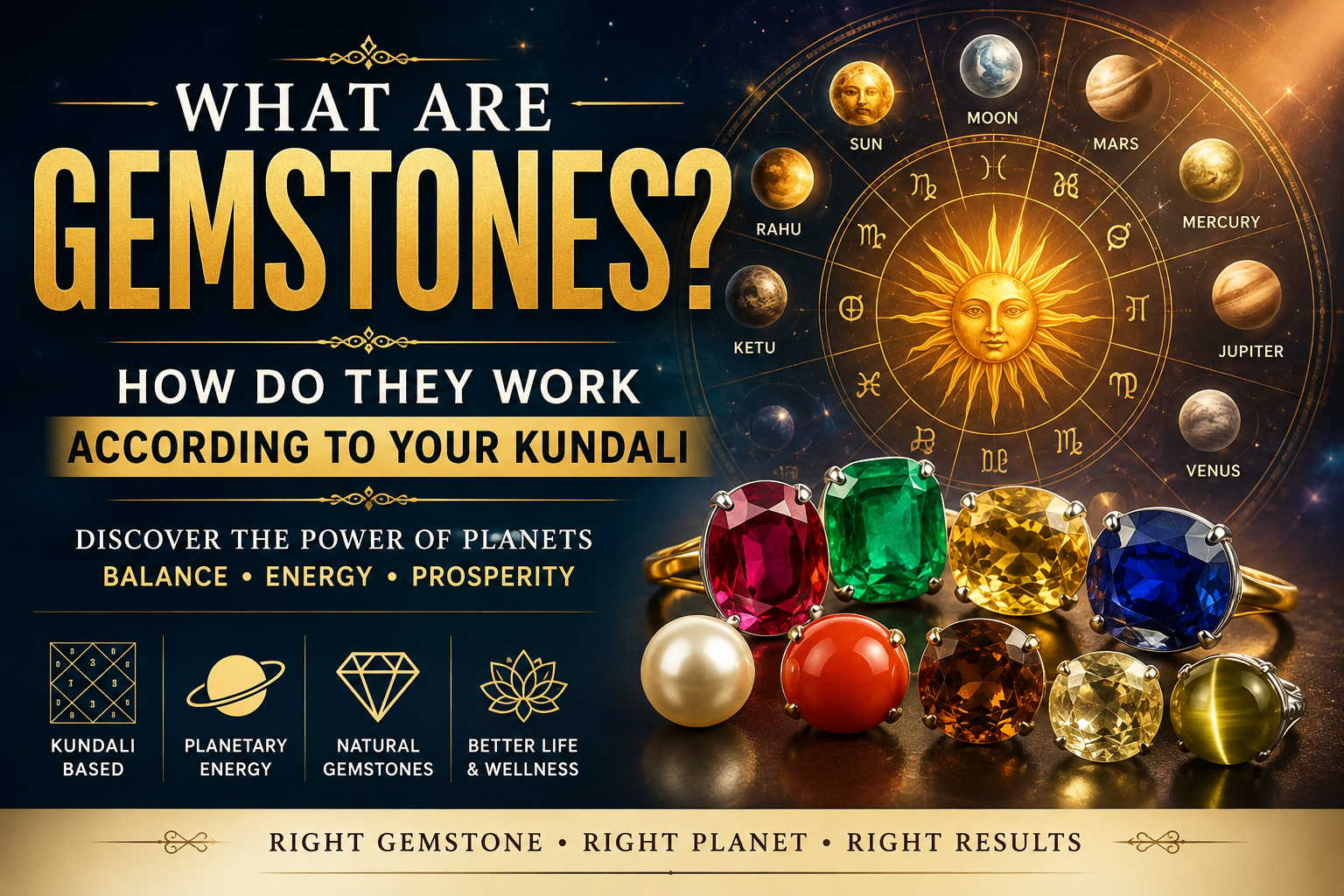
Gemstones have been an important part of Vedic astrology for centuries. Many people wear gemstones such as Ruby, Emerald, Blue Sapphire, Yellow Sapphire, and Pearl with the belief that they can strengthen the influence of certain planets in their birth chart.
But how do gemstones actually work according to a Kundali (birth chart)? The answer depends on your planetary positions, zodiac sign, houses, and the strength of different planets in your horoscope.
What Are Gemstones?
Gemstones are naturally occurring minerals or organic materials that are valued for their beauty, rarity, and unique physical properties. In Vedic astrology, specific gemstones are traditionally associated with the Navagraha, or nine planetary influences.
According to astrological tradition, wearing the appropriate gemstone is believed to enhance the positive qualities associated with a particular planet.
For example:
- 💎 Ruby – associated with the Sun
- 💚 Emerald – associated with Mercury
- 💛 Yellow Sapphire – associated with Jupiter
- 💙 Blue Sapphire – associated with Saturn
- 🤍 Pearl – associated with the Moon
- ❤️ Red Coral – associated with Mars
- 🤎 Hessonite (Gomed) – associated with Rahu
- 🐈 Cat’s Eye – associated with Ketu
- 💎 Diamond – associated with Venus
How Do Gemstones Work According to Kundali?
In Vedic astrology, your Kundali is prepared using your date, time, and place of birth. It shows the positions of the planets at the time of your birth.
Astrologers examine several factors before recommending a gemstone, including:
1. Planetary Strength
An astrologer may examine whether a particular planet is weak, strong, afflicted, or placed favorably in your Kundali.
Traditionally, a gemstone associated with a suitable planet may be recommended to strengthen that planet’s positive influence.
2. Houses in the Kundali
Each house of a birth chart represents different areas of life, such as career, wealth, relationships, education, health, and spirituality.
Therefore, simply choosing a gemstone based on your zodiac sign may not always be appropriate. The placement and role of the planet in your individual Kundali are also considered.
3. Ascendant (Lagna)
The Lagna, or ascendant, is one of the most important factors in Vedic astrology.
The same gemstone may be considered suitable for one person’s Kundali but unsuitable for another person’s chart because their ascendants and planetary relationships are different.
4. Planetary Periods (Dasha)
Vedic astrology also uses planetary periods called Dashas. An astrologer may consider the current or upcoming planetary period when suggesting a gemstone.
This means gemstone recommendations can vary as the interpretation of a person’s Kundali changes.
Popular Gemstones and Their Planetary Associations
| Gemstone | Planet | Traditionally Associated With |
|---|---|---|
| Ruby | Sun ☀️ | Confidence, leadership, vitality |
| Pearl | Moon 🌙 | Emotional balance, calmness |
| Red Coral | Mars 🔥 | Courage, energy, determination |
| Emerald | Mercury 🌿 | Communication, intellect, learning |
| Yellow Sapphire | Jupiter ✨ | Wisdom, prosperity, knowledge |
| Diamond | Venus 💎 | Luxury, relationships, creativity |
| Blue Sapphire | Saturn 🪐 | Discipline, responsibility, patience |
| Hessonite | Rahu | Ambition and unconventional thinking |
| Cat’s Eye | Ketu | Spirituality and intuition |
These are traditional astrological associations and should not be considered scientifically proven effects.
Why Should You Not Choose a Gemstone Randomly?
One of the most common mistakes people make is buying a gemstone simply because someone says it is good for their zodiac sign.
In Vedic astrology, gemstone selection is traditionally based on the complete Kundali, not just the Sun sign or Moon sign.
For example, a gemstone associated with Saturn may be traditionally recommended for one person but avoided for another depending on Saturn’s role and placement in their chart.
Therefore, it is better to have your Kundali analyzed before wearing a powerful gemstone, particularly gemstones such as Blue Sapphire (Neelam).
How to Choose the Right Gemstone?
A traditional gemstone selection process may include:
Step 1: Prepare your Kundali using accurate birth details.
Step 2: Identify the Lagna and important planetary positions.
Step 3: Analyze the strength and role of different planets.
Step 4: Consider the relevant houses and planetary periods.
Step 5: Select a gemstone traditionally associated with the suitable planet.
Step 6: Choose an appropriate quality, size, metal, and method of wearing according to the astrologer’s recommendation.
Natural vs. Synthetic Gemstones
When purchasing gemstones, buyers may encounter natural, treated, synthetic, and imitation stones.
If you are purchasing a gemstone for astrological purposes, it is important to understand what you are buying and ask for appropriate authenticity or laboratory documentation where available.
A gemstone’s value can depend on factors such as:
- Natural origin
- Color
- Clarity
- Cut
- Carat weight
- Treatment
- Origin
- Certification
Do Gemstones Really Work?
Gemstone astrology is based on traditional Vedic astrological beliefs, rather than established scientific evidence. There is currently no reliable scientific evidence that wearing a particular gemstone changes planetary influences or directly produces specific life outcomes.
Many people nevertheless choose gemstones as part of their spiritual, cultural, or astrological practices.
Therefore, gemstones can be viewed as a traditional astrological practice rather than a guaranteed solution to personal, financial, relationship, or health problems.
Final Thoughts
Gemstones are more than beautiful pieces of jewelry in the world of Vedic astrology. Traditionally, they are considered tools associated with planetary energies and are selected according to an individual’s Kundali.
The most important point is that there is no single gemstone that is perfect for everyone. Your birth chart, planetary positions, Lagna, houses, and Dashas should be considered before making an astrological gemstone choice.